


October 26, 2016
FOR IMMEDIATE RELEASE
Checking the mail is anything but routine at TDCJ
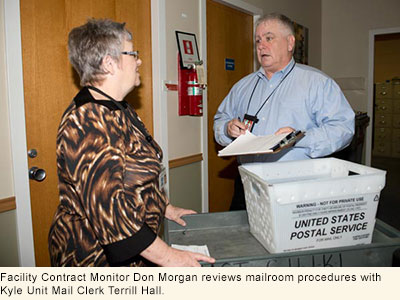 Correctional facilities are often compared to small towns. There's a store, a water tower, maintenance and yard crews, and like most towns there's an area where the mail is received and delivered to its residents. Correctional facilities are no different.
TDCJ employees across the state of Texas process the incoming and outgoing mail of a 147,000 offenders daily which is greater than the population Waco. Jennifer Smith is the agency's Mail System Coordinator. She says it can be a daunting task but employees do an incredible job of sifting through letters and packages, as well as newspapers and magazines, to ensure that all rules and regulations are followed and mail is delivered in a timely fashion to the offender population.
"In 2015, we screened over 22 million individual pieces of mail and over 212,000 incoming packages. More than 2.5 million e-messages were also reviewed," Smith said. "It's astonishing when you really think about it."
Donna Little knows a thing or two about the mail. She recently retired after spending 40 years working for the United States Postal Service. She quickly grew bored after a few months of retirement and began looking for a new job. She came back to occupation she knows well.
"I came to work for TDCJ last November. I never really envisioned working in a prison," Little said while sorting mail at the Huntsville Unit. "I was a rural carrier for many years. I'm still delivering the mail but my route is certainly different."
Before the mail is delivered to an inmate, staff opens and inspects incoming and outgoing correspondence looking for gang codes, escape plans, and physical contraband among other things. Smith says staff must stay attentive while processing mail. Both offenders and those outside the perimeter fence will go to great lengths to circumvent security measures.
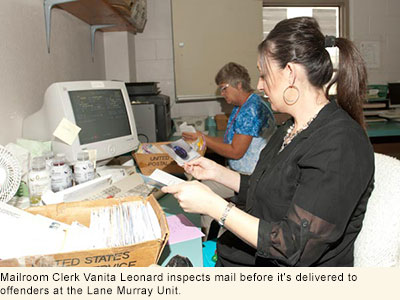 "We have found drugs hidden inside greeting cards, money sewn into the backs of books, you name it we've probably seen it," said Smith.
Offenders may send sealed and uninspected letters directly to media, legal, and those designated as special correspondents such as lawmakers, law enforcement officials, as well as, the Texas Board of Criminal Justice.
Murray Unit assistant warden Kim Massey began her career with TDCJ at the age of 19 working in a mailroom at the Hughes Unit. Looking back she realizes how the staff plays such an important role in keeping offenders connected to the outside world but also to overall security of the institution.
"I learned the importance of trusting your co-workers, communication, working as a team, and how having comradery would make everyone successful. With this knowledge, I knew the unit would be a safe and secure facility and that was a huge impact on how my career would evolve."
Secure, regulated contact by means of an effective prison mail system is a normal and necessary part of an offender's successful rehabilitation. TDCJ's mail services help the agency to achieve its mission to promote positive change in offenders by enabling them to correspond with their families, friends, legal representatives and others.
###