An employee publication of the Texas Department of Criminal Justice
Summer 2025
A Community of Support
For the women in the program dorms behind the gates of the Patrick L. O’Daniel Unit, they are more than just inmates; they are a community. Day in and day out, they share their life experiences with each other, serve as cheerleaders for their successes, and act as a shoulder to lean on when life gets to be overwhelming.
Camaraderie, accountability and mentorship are the cornerstones of life in each of the five program dorms, where these words resonate deeply among the women.
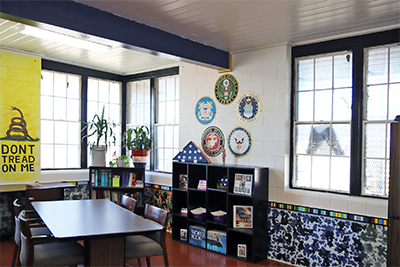
A shining example of this supportive environment is in the S.T.A.R.S veteran’s dorm; S.T.A.R.S. stands for Service Through Action Reveals Strength. The women in this dorm take pride in their identity and the standards they have set for themselves.
“This program is special to us because when we are outside of this dorm and performing our duties, we are viewed differently by other inmates. It gives us a sense of pride, even though we’re locked up, that we can set a standard of living that encourages others to meet those standards as well,” dorm member Anna Ruiloba said.
The women in this dorm have collaborated to paint their dorm and worked together to acquire coping habits such as learning to play the piano and soon, the guitar.
According to Joyce Turner, another member of the S.T.A.R.S. dorm, these dorms provide them with the mechanisms they need to cope with hardships while building relationships that expand beyond prison gates.
A lot of our sisters have gotten out and they’re reaching back in to say hi and sharing about their life. It gives us a chance to pray for them. We are trying to build an alumnus, so our support remains in here and after release,” she said.
That camaraderie past the gates is a common experience among program dorms. Kristin Gamez, a coach and mentor in the Recovery Housing Opportunity Program (RHOP), emphasized this. RHOP is a voluntary program where women live and work together to understand the foundations of recovery and sobriety, discovering what their lives can look like beyond addiction.
“As a coach and a mentor, we try to meet everybody but there are also those that we just connect with, and we can grow with each other,” she said. “What we are doing in here is translating out there. I have a friend now, no longer a peer, but a friend who is making her life work using the tools that we learned here. That has been a blessing when they reach out and we get to hear and commend the women out there that have been here.”
While the paint here is different and the living area set up for a class, the overall feeling in the room was one of comfort and healing.
Gamez stated that living in the dorms as a coach has been a positive experience.
“Everyone is here to grow and progress and having similar goals allows us to bring positivity into what we are going through and care about each other in the moments that are really hard,” she said.
For Andrisela Ng, RHOP helped her realize her drive to show other women they are not alone in their battle.
“I took the program and then I became a mentor. Before this program, I didn’t realize that sharing different struggles with people who have been where you are really helps to process and network. It helps you learn the right way to cope and then you can adopt what works for you. Now, as a mentor, seeing their growth is exciting,” Ng said.
Similar to RHOP, the transitional dorm is focused on mindset, but not just for sobriety. This is where the life coaches are located and bring their mission of promoting positive change in inmates’ behavior to life.
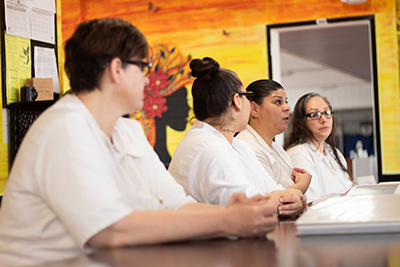
Inmates at the O’Daniel Unit in a discussion.
The transitional dorm at the Patrick L. O’Daniel Unit was established originally as a behavioral modification dorm for inmates preparing for release. Now, it is available to anyone who is ready to change.
In this dorm, life coaches focus on teaching how your thoughts influence your feelings, which in turn influence your behavior.
Life Coach Enedelia Canales has been incarcerated for more than 15 years. The transitional dorm created a sense of community for her.
“Living in this dorm makes a difference in how you interact with others and even the way you take care of the things that happen in prison. Because it is clean, you can walk in and it makes you take a deep breath and realize that you’re okay,” she said. “It makes a difference in your mental, emotional and physical health.”
Much like Canales, Marcie Moon has been in prison for 31 years and commended the increase in programming similar to these dorms.
“When I got to prison, we didn’t have programs like this, but I really think the programs are helping,” Moon said. “We have success stories and people who are sincerely making changes. I know that it has helped me tremendously and changed my life.”
Similarly, Angelita Salinas said that coming to the transitional dorm was full of positivity.
“It is really benefitting me because I came into the system at the age of 15 then got transferred to TDCJ at 17 years old,” Salinas said. “I wasn’t in a good headspace and my mentality, and my maturity wasn’t where it is at now. This dorm and the life coaches have helped guide me in understanding others and figuring out what I need to do next.”
“If I hadn’t come to prison, I would still be a high school dropout with no education and now I plan on going to college which is something I always imagined but never realized was possible for me,” Salinas said. “It is giving me chances that I never had in the free world, and it is showing me that success can happen no matter what your background is. It will be hard to get there but there are greater things for me beyond my release.”
The STRIVE dorm provides women with the same knowledge that Salinas now has and places them on the path to success before even leaving prison. They work daily to teach the values of their name, Strength Through Restoration, Independence, Vision and Empowerment. The program prepares women for reentry through gender-responsive, trauma-informed programming, career skill development, employment and community support referrals.
“Whenever we leave and get to go home, the STRIVE program gives us clothes, shoes, and hygiene care. We also leave with a job, and everyone has a home plan and somewhere to go,” STRIVE cohort member, Tommi Cherry said.
Another STRIVE cohort member, Evelyn Shires said, “I have been locked up for 30 years and now I am about to go back into the world. This program is huge for someone like me because I don’t know that world out there. I get overwhelmed just thinking about it and in this program, I am surrounded by women and mentors who remind me that I can do this.”
These shared, lived experiences are the backbone of TDCJ program dorms and imperative to the overall success of the inmate. They allow those incarcerated to leave TDCJ not only with the tools they need to be successful, but also with a support system that will last a lifetime.