An employee publication of the Texas Department of Criminal Justice
Summer 2025
Closing the Loop: Office of Family Services
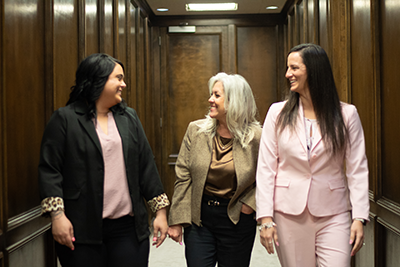
Left to right: Brandie Coffman, Susan Gunnels, and Briana Pope
Having a loved one confined in a correctional facility can be a difficult and emotional struggle for family members. The Texas Department of Criminal Justice (TDCJ) is one of the largest correctional agencies in the world, not only in inmate population, but also in geographic size.
To the public, the inner workings of TDCJ may seem vast and complex. So what does a family member do when they have a question or are confused by a procedure? When they hear a rumor? Or when they receive a phone call or letter about an issue from their incarcerated relative?
They reach out to the Office of Family Services (OFS).
To bring a more personal touch to issues from family members, the OFS was created in the Executive Director’s office to provide an outlet for information and referral for inmate families and advocacy groups.
Susan Gunnels was the manager of the OFS, but was promoted to the Deputy Director of the Office of the Independent Ombudsman at the time this article was published.
Gunnels views the office as critical to addressing inquiries, investigating concerns, and seeking resolutions that uphold transparency and trust.
“By ensuring that vital agency updates and opportunities are communicated effectively,” Gunnels said, “we strive to empower families and organizations with the information they need. Every interaction is an opportunity to make a difference, ensuring that those in need feel heard, valued and supported.”
Looking forward, Britteny Skains has since been selected to lead the OFS, effective July 1. She has more than 20 years of criminal justice experience and has held a variety of positions within TDCJ as well as the Montgomery County Sheriff’s Office.
“I am honored to lead the Office of Family Services and continue its vital work,” Skains said.
This transition ensures the continued dedication of the OFS to its mission of supporting families and fostering open communication.
Brandie Coffman and Briana Pope also work in the OFS. Coffman has worked at TDCJ for 15 years, beginning as a correctional officer and rising through the ranks to captain at the Wainwright Unit. This experience motivates her to help the agency and the executive leadership communicate effectively with advocacy organizations and loved ones of incarcerated individuals.
“I personally believe that providing knowledge of an environment that has largely been closed off to the general public, can be most beneficial in assisting loved ones of the incarcerated,” Coffman said. “Time in this job has shown me that when families, advocacy organizations and incarcerated individuals are able to receive good and reliable information, it plays a big part in the agency’s mission to rehabilitate individuals.”
In her five years with the agency, Pope has worked as a warden’s secretary at the Beto and Holliday Units, which provided her experience with handling inmate issues as well as working with inmate families.
Pope gets her motivation to work in the OFS, because of her experience being the loved one concerned about an incarcerated family member.
“I have a kind of unique ability to understand both views. I know first-hand what it is like to have an incarcerated family member. It helps me merge the gap between inmate families and the agency while working to accomplish the TDCJ mission,” she said.
The OFS trains, supports and coordinates with the Family Liaison Coordinators (FLC) at the larger population units. The FLCs are the go-to on the unit when there is a significant question or a concerned phone call from an inmate’s family.
The FLC is selected because of their level of experience and knowledge about unit operations and management. Along with their experience, they tend to have a natural ability and motivation for helping others. At the Wainwright Unit, that person is Debbie Phillips.
With 21 years on the Wainwright Unit, Phillips, a US Air Force veteran and Crisis Response Intervention Support Program (CRISP) Team member, champions the role of the FLC, “to maintain ties with inmates and their families to ultimately reduce recidivism.”
The FLC provides families with information about an inmate’s classification status, their location and any healthcare issues. “We also relay to an inmate any news of emergencies or other necessary information their family needs them to know,” Phillips said. At times, she has had to provide family death notifications and follow-up support for inmates.
Hot topics for the FLC include changes to procedures at the units, especially concerning visitation, such as the recent changes for purchasing items from unit vending machines. There are a lot of questions to answer about tablets, inmate property and medications, especially when an inmate is moving to another unit or when changing their custody level.
Like Phillips, Karen Coffindaffer, FLC at the McConnell Unit in Beeville, brings a ton of experience to her position. Coffindaffer started her career at TDCJ in 1992 and has held positions as warden secretary, grievance investigator and disciplinary supervisor at McConnell, Connally and Garza East and West.
“Each position that I have had the privilege of being selected to perform has assisted and prepared me for the job that I accomplish each day as a family liaison coordinator,” she said.
For Coffindaffer, providing families with timely information and answers to questions, which helps ease confusion and fears, is one of the rewarding aspects of her job.
“I am able to assist wardens and other departments from having to stop their duties, and that means families of inmates don’t have to wait too long for responses,” she said.
McConnell Unit Warden Larissa Wysocki emphasized the importance of FLCs to a unit.
“The FLC can be a valuable asset to a warden, promoting a more supportive and rehabilitative prison environment,” Wysocki said. “An FLC can foster stronger relationships between the prison administration and inmate families, promoting trust and cooperation.”
In addition, the FLC can:
Facilitate open communication, ensuring families are informed about prison policies, procedures and inmate well-being;
Encourage support for inmates’ rehabilitation programs, increasing the likelihood of successful reintegration;
Help resolve issues and concerns between families and prison staff, reducing tensions and potential conflicts;
Contribute to improved inmate morale, reducing stress and behavioral issues; and
Help maintain community ties for inmates, which is crucial for rehabilitation and reducing recidivism.
Many of the questions and concerns can be easily addressed, but there are situations where a more in-depth investigation is necessary. Every family inquiry is logged and the FLC enters pertinent information into a shared database, which provides useful diagnostic information for all the FLCs.
According to Gunnels, “The FLC or OFS staff may not be the subject matter expert for every call or question. But we are going to ‘close the loop’ and provide the family with a response.”
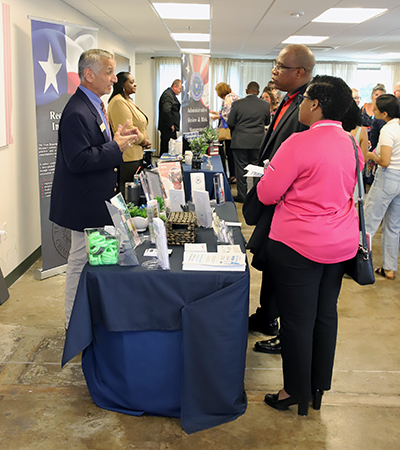
Rehabilitation and Reentry Division manager, Leonardo Colunga, discusses issues and answers questions for an inmate family at the 2024 SUMMIT.
The OFS works closely with different advocacy groups, as well. One of these is the Texas Incarcerated Families Association (TIFA). Founded on March 30, 1996, TIFA is now the largest such association in Texas. TIFA is almost always in contact with the OFS and the FLCs at the units. Their goals are to provide information to families who have a loved one incarcerated in a TDCJ facility.
Through cooperation with the OFS, TIFA coordinates subject matter experts from TDCJ divisions to share information with its members.
“We provide new member orientation, and we are always reaching out to Susie Gunnels to arrange for presentations for our members on topics such as commissary, visitation, inmate tablets and medical. When a question or issue arises, we start with Susie!” Former TIFA Executive Director Sharon McKinney said. “For example, an inmate’s family members may believe their loved one is not getting fed or allowed to get a shower or go to commissary, the OFS can swiftly calm those concerns.”
The OFS is also responsible for planning and managing the TDCJ SUMMIT. Held at different times during the year and around the state, the SUMMIT provides families an opportunity to have open conversations with leaders from all of the TDCJ divisions, Board of Pardons and Paroles and Windham School District.
According to Gunnels, it’s a chance for families to meet TDCJ staff and see how all the TDCJ divisions affect the daily lives of inmates and parole clients.
“Agency representatives give presentations and engage with attendees, fostering understanding of available programs and services that support rehabilitation and reentry efforts,” Gunnels said. “Open to the public, these events emphasize the crucial role of family involvement in helping loved ones navigate their journey, strengthening community ties and promoting positive change.”