June 2024
Cutting-Edge Learning Technology: Virtual Reality Training Delivers Innovative Solutions
by Marissa Nuñez
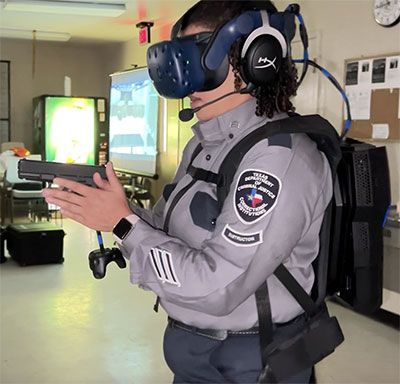 Texas, one of the nation’s largest states, boasts 254 counties that sprawl for hundreds of miles. This vastness makes the Texas Department of Criminal Justice (TDCJ) one of the Lone Star State’s biggest agencies. However, this very size can create challenges, particularly in delivering essential training to TDCJ staff and officers spread across the state.
Recognizing this obstacle, the Training and Leader Development Division’s (TLDD) TDCJ Online team set out to find solutions. In 2021, a collaborative effort began between TLDD and other agency divisions to address the challenge of providing cost-effective training for staff unable to travel to TDCJ headquarters in Huntsville. Their solution? Leveraging online training and cutting-edge learning technology.
“We have helped the agency save money by cutting back on travel costs and lodging,” Saphon Ren, TDCJ Online supervisor said. “In terms of learning impact, the combination of design aesthetic and online assessments have proven to be a successful strategy for driving continuous learning and development.”
Ren and her team script, design, and build the online training modules. This process typically requires a dedicated effort of four-six weeks, or approximately 400 hours. The completed modules are hosted on a learning management system (LMS) like Blackboard, allowing TDCJ staff to access them conveniently around the state. The interactive format keeps participants engaged with the curriculum, facilitating better retention of the material.
The online platform also offers flexibility for participants to complete modules at their own pace, enabling them to balance training with their daily tasks. This approach also ensures consistency in training delivery, guaranteeing all staff receive the same high-quality training.
“We’ve also seen an impact on time efficiency and staff satisfaction. Keeping staff at their offices to complete their training means a lot to them,” Ren said. “Additionally, online training offers a level of consistency that can sometimes be lacking in traditional in-person instruction.”
The innovation doesn’t stop there. With the evolution of technology, the agency began looking into ways to implement a virtual reality (VR) component to staff training. It was made possible through a $1.25 million grant from the Bureau of Justice Assistance to provide crisis response intervention training for correctional, parole, and probation officers. The VR training uses real-life simulations to further train officers.
 “Virtual reality allows us to train in a more immersive way,” TLDD Deputy Division Director Matthew Ade said. “There are certain job aspects of a correction, parole, or probation officer that can have an element of risk and VR allows us to recreate those type of scenarios and situations in a safe environment. It’s not a replacement for in-person training, but rather a valuable tool to enhance our existing programs.”
By embracing online education and VR, the agency bridges the geographical divide inherent in a vast state like Texas. This fosters a more unified culture, bringing TDCJ staff together despite the physical distance.
“Technology has the potential to significantly improve efficiency, and I believe we’re on the right track,” Ren said. “We’re excited to be part of this innovative movement and continue to embrace this forward-thinking approach.”


