December 2023
Predicting to Prevent
by Roxanne Moss
 Suicide has historically been a leading cause of death in prisons. According to the National Institute of Corrections, “rates of suicide are far higher than the national averages.” The need for preventing carceral suicide is urgent.
The Texas Department of Criminal Justice considered this need and assembled a special team of Research and Development, Correctional Institutions Division and Victims Services Division staff to work towards a solution.
Their in-depth examination of carceral suicide identified statistical analysis and the necessity of safe spaces as criteria for developing the agency’s self-harm prevention program.
In 2021, the Research and Development team began a statistical analysis. As explained by Andrew Barbee, Director of the Research and Development Department, their assignment “was two-pronged; first, work with executive services to gather data, compile a database and form a risk assessment screening tool with an algorithm that made sense, and then enlist health and wellness services, University of Texas Medical Branch and the Texas Tech University System for access to inmate health records. Mr. Collier wanted to understand suicide and somehow quantify it. This was the basis of our assignment.”
The next task was “suicide distinction,” a means of capturing suicide in stages to determine at-risk classification.
The last task was constructing the algorithm for the risk assessment screening tool. It was daunting.
Barbee described the algorithm’s job as “scanning the database to identify and sort inmates by suicide distinction, combining diagnostic terms and inmate records with that distinction, and returning an accurate at-risk classification. The output would be a daily report, identifying inmates at risk on a unit while relaying a quantified percentage of those inmates compared to the total inmate population.”
The risk assessment screening tool was put into action last year. The results from the first year were promising. Barbee described the risk assessment screening tool as “classifying 6.5 percent to 7 percent of the inmate population as being at risk and accurately predicting 50-55 percent of all suicides and self-harm events.”
The second-year goal for the tool is to accurately predict 65 to 70 percent of all suicides and self-harm events. The enhancements for the tool to meet that goal will begin when the Correctional Information Technology System installation is complete.
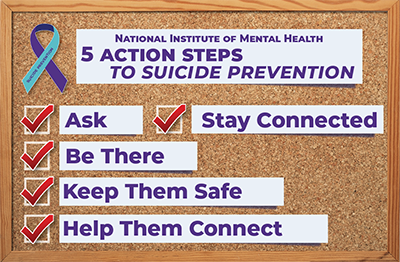
In addition to the risk assessment, self-harm prevention offices were established. TDCJ is currently operating 16 pilot offices. The provision of staff for these offices is a collaboration between Correctional Institutions Division employees and peer support coaches, also referred to as self-harm prevention specialists. These offices use inmate peers to interact with the at-risk inmate population to build connection and reduce isolation. The need to leverage these resources and offer training prompted the implementation of the five-step action plan by the National Institute of Mental Health. The five action steps are ask, keep them safe, be there, help them connect, and follow up.
Mary McCaffity, Deputy Director of the Victims Services Division, explained that Employee Support Services works in conjunction with other agency departments to advance suicide prevention initiatives across the agency.
McCaffity elaborated that “they train on this continually, they talk about these five action steps all the time. Our support staff and peer coaches use these steps to connect.”
Some of the inmate peer support coaches have taken additional steps to enhance their one-on-one connection. At the Robertson Unit, 70 peer support coaches rotate their shifts to give inmates comfortable engagements with their favorite coach.
Inmate Brandon Coppock, a self-harm prevention specialist at the Estelle Unit, offered insight on the activities of the program.
“A lot of what we do is just going around creating and cultivating relationships, talking to people in their housing area who are going through different things. A lot of these guys are already on our risk tool, so they are on our radar,” Coppock said. “But we may also come into contact with other inmates on the way. They may stop us in the hallway, know we are self-harm specialists and say ‘Hey, I really need to talk to you.’”
He shared an additional acronym: listen, observe, validate, and emphasize (LOVE), and explained that they apply this acronym when talking to those additional inmates.
“We teach LOVE, to love them, to tell them we love them, to emphasize that we really do care about them.”
The TDCJ suicide prevention program is still in its infancy, but it has broadened the lens of carceral suicide behind bars and in front of them. Combining risk assessment with human connection has created daily opportunities to lessen suicide and stop self-harm within the agency. The plan for growth is multifaceted, with the focus remaining on predicting suicide to prevent it.
“The staff that is working inside these offices and the inmates that work in it have to have a heart; they have to have the want and will to change people, to help people out, and care about people,” Estelle Unit Food Service Major, who assists with the suicide prevention program, Jennifer Helm said.
The initiative isn’t just for inmates, but staff as well.
“There are as many staff members coming into these offices as there are inmates,” McCaffity said. “Sometimes they come to take a time out, maybe they need to decompress from the noise, or there could be something personal going on they need to talk about. When they leave, they feel better. That’s what we want to happen. This is who we want to be as an agency.”


