An employee publication of the Texas Department of Criminal Justice
December 2023
Virtual Recovery: Using the Power of Technology to Help Inmates
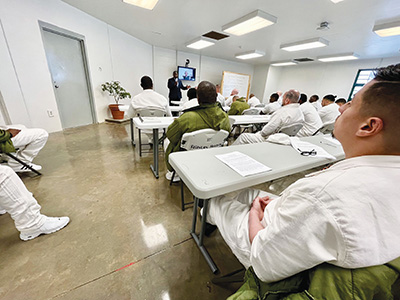
RPD Director, Chris Carter talks to inmates about the new Technology Assisted Treatment Program.
The road to recovery can be long and filled with many obstacles that can be hard for an individual to overcome without the proper resources and support.
For incarcerated individuals, navigating that road can be even more strenuous.
The Rehabilitation Programs Division (RPD) provides these important services and support to the inmate population. They work diligently to develop new and innovative programs for the men and women in TDCJ facilities.
In 2020, when the COVID-19 pandemic hit, the world was faced with having to adapt to a new way of life. For the agency, it was learning how to use the power of technology to serve the inmates in the In-Prison Substance Use Treatment Program. From there, the Technology Assisted Treatment Program was created as part of an agency-wide effort.
“The Technology Assisted Treatment Program really came to many people’s thoughts and has been something that we [TDCJ] have discussed before,” Deputy Director of the Substance Use Treatment Programs Andrea Canul said. “Then the idea was really pushed with COVID, because a lot of the world was going virtual.”
The program, which was first implemented in April 2023 at the Polunsky Unit in Livingston, gives inmates the capability to visit virtually with a substance use counselor individually and in group settings.
As part of the program, inmates undergo 15 direct service hours with a substance use counselor over a span of six months. They are housed in an in-person therapeutic community where inmates who have similar treatment needs live together and help with each other’s addiction recovery and developing positive behavior.
Canul said the program helps inmates not just work on their recovery but really learn about addiction and the effects it has on an individual.
“We have inmates who have done some serious time, and they have reported that there are certain things about substance use that they’re now learning,” Canul said. “The program definitely has had a positive impact and it’s something we’re going to continue to use.”
RPD Director Chris Carter said the program has had a huge impact on the inmates who are participating in the program, the division and agency as a whole.
“The new virtual substance use treatment program has truly enhanced RPD’s ability to administratively assign individuals to an intensive treatment program,” Carter said. “This program was developed to provide individuals treatment based on need, and not primarily focused on sentence length and parole eligibility status.”
According to Carter, this model has proven to be a major game changer in the lives of the participants.
“I have personally witnessed testimonies on how the treatment sessions have empowered them to maintain a healthy lifestyle free from drugs and alcohol,” Carter said. “Virtual programming allows our agency to deliver quality treatment, increase productivity, maximize resources and reduce cost in the future.”
The agency is beginning to look at expanding the program to other units, as well as how other programs outside of substance use treatment could benefit from using the Technology Assisted Treatment Program.