An employee publication of the Texas Department of Criminal Justice
December 2023
Crisis Programs Offer Support and Hope: In This Together
by Communications Staff
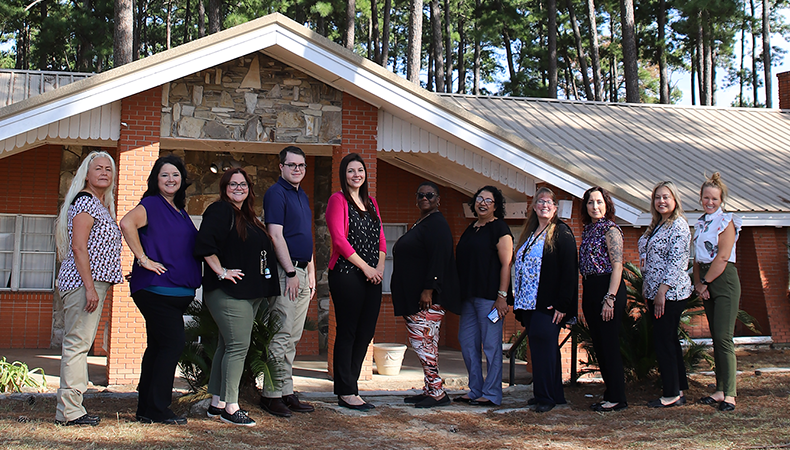
ESS Program members, left to right: Linda Gonzales, Tracie Sible, Jordan Schlafer, Caleb Taylor, (executive assistant to McCaffity), Mary McCaffity, (Deputy Director, Victim Services Division), Gidgett McKnight, Sumer Wassef, Trisha Boardman, Dawn McKeehan (ESS Manager), Brenda Gutierrez, and Connie Kennard.
While corrections can be a rewarding career for many, the inherent danger of working with incarcerated individuals, as well as the extraordinary stressors associated with the job, can seriously affect the well-being of staff. When this happens, TDCJ’s Crisis Response Intervention Support Program (CRISP) is available to help.
Established in 2008, CRISP is always ready to lend a hand of support when needed. Specially trained staff impact teams, who are distinct from CRISP but managed through the Victim Services Division’s Employee Support Services (ESS) section, are ready to provide valuable services that include critical incident support and debriefing, peer support, information and referrals, as well as follow up support. ESS staff victim advocates are available to help should you become crime victim of a crime while on the job.
Your CRISP team members work with you or near you; they are your fellow TDCJ employees. They understand the nature of working for TDCJ, because they work for TDCJ. They also are continually trained and equipped with the knowledge and tools to help you through a crisis or trauma. Whether they are on your unit or a neighboring office or region, CRISP team members are ready and able to assist.
To request ESS support, you can talk to your supervisor or contact your regional ESS member.
At TDCJ, we are not immune to or free from potential significant traumatic events, stress and burnout, alcohol dependency and substance use, accidents, crime, or domestic and family violence. As the CRISP program has developed, more and more team members began to express a need for extended peer support for traumatic events that happen on the job and in our daily lives.
While your CRISP team members are available to provide critical incident support, ESS staff also provide peer support interventions as well as extended information and referral services for a number of situations, including mental health concerns, anxiety and depression, suicide awareness and prevention, and protective orders. ESS staff can help you understand and exercise your statutory rights as a crime victim, provide guidance with Texas Crime Victims’ Compensation claims, and support you through the criminal justice process. ESS staff also provide training and support for CRISP team members across the agency.
Crisis Support When She Needed It
In June 2023, Shantora Greggs was on a cruise with her husband when they got a phone call letting them know that their two-month-old grandson had suddenly died from an unexpected medical condition. Stunned from the news and dealing with her grief while also trying to provide comfort and support for her grieving son and the rest of her family, Greggs, a long-time correctional officer at the Ellis Unit, sought out support from her unit CRISP team.
Busy with the difficult planning of her grandson’s memorial service, CRISP team members provided peer support and care for Greggs but also stepped in to find a venue and arrange for the memorial service repast. The team had everything set up and helped with serving the food and refreshments for those who attended. They even brought a gift in memory of her grandson.
Greggs found comfort in the care and support of her CRISP team when they were needed. She also said it is comforting to know she has this kind of peer support. She is grateful for how they stepped up and exceeded her expectations in her and her family’s time of need.